
Paranoid by design
When privacy becomes a luxury, people start building their own tools. A small LoRa device, growing distrust in modern infrastructure, and one uncomfortable question: when did we accept that our entire lives should pass through someone else’s servers?
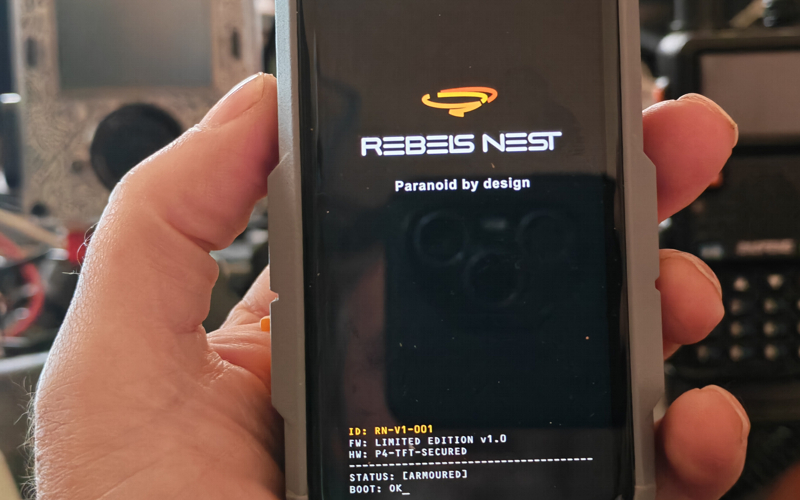
There was a time when paranoia meant thinking someone might be watching you.
Today, paranoia is thinking they probably aren’t.
The phone in your pocket is no longer just a communication device.
It’s a GPS tracker, microphone, contact archive, behavioral map and voluntarily
carried sensor quietly reporting where you’ve been, who you talk to and what
keeps you awake at 2AM.
And of course, all of it exists “to improve user experience.”
Modern technology became so smart that the user is slowly becoming the dumbest part of the system.
Every app wants:
- access to your camera,
- microphone,
- contacts,
- location,
- photos,
- browsing habits,
- soul,
- family tree,
- and probably blood type the moment Apple and Google expose it through an API.
Meanwhile, “the cloud” may be the most successful marketing trick of the modern era.
Someone convinced billions of people that uploading their entire private lives onto someone else’s servers was not only normal — but convenient.
And somehow we all agreed.
Not because people are stupid.
Because convenience is addictive.
One click.
One login.
One sync.
One more silent surrender disguised as simplicity.
Eventually you wake up in a world where nearly every conversation, movement, photograph, document and relationship depends on infrastructure you neither control nor fully understand.
You don’t own the network.
You don’t own the platform.
You don’t own the operating system.
In many ways, you barely own the device.
And no — this is no longer some dramatic cyberpunk fantasy.
This stopped being abstract when I started hearing what happens to phones in police stations. Not just somewhere far away. Here. In Serbia. Phones get confiscated during "informative conversations." When they come back — if they come back — something is always off. Battery life changed. Settings rearranged. A quiet feeling that someone walked through everything before handing it back.
Journalists talk about this openly now. Source protection isn't just ethics anymore. It's engineering.
Even ordinary people have started noticing that something feels deeply wrong.
Too much tracking.
Too much telemetry.
Too much dependence on systems nobody voted for and nobody can audit.
That’s where this project began.
Not as a hobby.
Not as another ESP32 toy.
And definitely not as some “end of the world prepper gadget” assembled in a basement between canned beans and conspiracy podcasts.
It started with a simple question I couldn’t shake off:
What would communication look like if we stopped assuming permanent dependence on centralized infrastructure was normal?
For months I explored LoRa devices, mesh networking experiments and decentralized communication projects. Most were technically impressive… but looked like unfinished school science projects held together by zip ties, exposed PCBs and pure optimism.
Functional? Sometimes.
Something a normal person would actually carry every day? Not really.
Then I discovered LILYGO T-Display P4 with LoRa SX1262.
And for the first time, the idea clicked.
A proper screen.
Battery powered.
Compact.
Clean.
A device that looked like an actual product instead of an engineering accident.
For the first time, decentralized communication stopped feeling like a niche experiment for radio enthusiasts and obscure GitHub repositories.
It started feeling possible.
That’s how the Rebels Nest firmware started.
Slowly.
Stubbornly.
Without investors, startup buzzwords or PowerPoint slides promising to “disrupt
the communication ecosystem.”
Just one increasingly uncomfortable realization:
Maybe people deserve technology that belongs to them.
Not technology that constantly reports back to someone else.
I’m not claiming a small LoRa device can magically solve surveillance, privacy or digital control.
It can’t.
And I’m definitely not naïve enough to think people will suddenly abandon smartphones and disappear into the woods carrying antennas.
But maybe there’s room for something in between.
A communication device that:
- minimizes dependence,
- avoids unnecessary telemetry,
- respects the user,
- works independently,
- and doesn’t assume constant connectivity should define modern life.
Maybe this is just a paranoid experiment.
Or maybe, in a few years, devices like this will seem as normal as smartphones once did.
Honestly, I don’t know yet.
That’s why I’m writing this publicly.
To see whether I’m alone in thinking the modern digital world has become a little too invasive.
To find out whether people still care about ownership, autonomy and privacy — or whether we quietly traded all three away for convenience and push notifications.
Would you use a device like this?
Does the idea sound reasonable, unnecessary… or inevitable?
At what point did we collectively accept that our entire lives should flow through servers owned by corporations, governments and platforms we neither trust nor control?
If you have thoughts — positive, negative or deeply paranoid — I’d genuinely like to hear them.
If you work in communications, security, journalism, embedded systems, LoRa, radio or decentralized networking… even better.
Because maybe this is nothing.
Or maybe we’re watching the beginning of a completely different kind of personal technology.
The Rebels Nest firmware already exists.
The hardware exists.
The idea exists.
Now I’m just trying to figure out how many people have been thinking the exact same thing in silence.
I'm not building this in a basement for myself. If you've been thinking the same thing, you're not alone.
Do you think the same? Get in touch.
one@rebelsnest.com